Not all 20-foot containers weigh the same. Before you buy, move, or set yours down, check its empty weight, the weight of what you'll put inside, and the limits shown in its documents. These numbers are used for different checks.
The technical example on this page shows an empty weight of 2,350 kg for a standard 20-foot container. It's there to explain the calculations and doesn't describe the container you're buying. Before the move, make sure you confirm your container's weight, its equipment, and the conditions for moving it.
Documented example · 20-foot standard
| Tare · empty weight | 2,350 kg |
|---|---|
| Maximum payload | 28,130 kg |
| Maximum gross mass | 30,480 kg |
Example from a documented fleet, checked on 16 October 2026. Values vary by manufacturer and do not describe Container Origin stock. Check the selected unit’s markings and documentation.
Calculate the mass to move
Calculation example: 2,350 kg tare + 10,000 kg contents = 12,350 kg to move. This example does not authorise loading or lifting your unit.
Distinguishing empty weight, payload, and gross mass
Tare weight is the container's weight without any load. Maximum payload is the heaviest load allowed under the conditions stated for that container. Maximum gross mass is the limit for the container and its contents together. The formula is: maximum payload = maximum gross mass − tare weight. You also need to check the floor, how the load is spread, and the equipment that will move it.
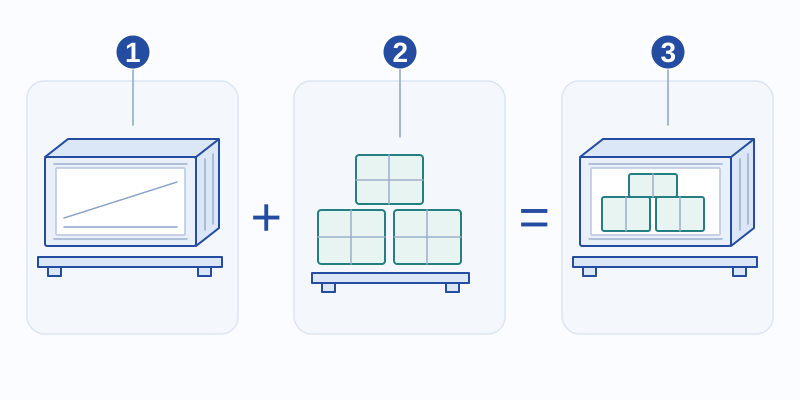
Visual reference
- Empty container
- Contents mass
- Total gross mass
Illustrative diagram, not to scale.
The standard model's spec sheet used as an example shows a tare weight of 2,350 kg, a maximum gross weight of 30,480 kg, and a maximum payload of 28,130 kg. These figures are for the same model. Don't mix the empty weight from one spec sheet, another manufacturer's limit, and a capacity you saw in a picture.
| Situation | Information needed | Don't confuse with |
|---|---|---|
| Buying an empty box | Empty weight with the equipment actually fitted | An average found for the same size |
| Moving the loaded container | Confirmed empty weight and the full weight of everything inside | The maximum payload by itself |
| Storing a heavy load | Weight of contents, support points, and distribution on the floor | A total limit that would allow everything to be placed on a single point |
| Comparing a modified container | Data and documentation after modification | The original data sheet before conversion |
Check that the markings match the container being offered
Ask for the container number, clear photos of the weight markings, and its documents. Check that they match the photos in the listing, the quote, and the container that will be delivered. A 20-foot listing with an indicative weight does not necessarily identify the container you will receive.
Ask what the advertised empty weight includes, especially after repairs or a conversion. Shelving, cladding, installations, and added furniture must also count in the weight to be moved. If the documents no longer describe the current container, ask the supplier and the service provider how to find out its actual weight. Do not replace missing information with an estimate presented as certain.
Count all contents, including pallets and packaging
List each item and its weight. Include pallets, packaging, bins, and accessories that will stay inside during the move. Specify what will be added after delivery or removed before pickup. A list without weights does not allow you to prepare the transport of a loaded container.
Adding the empty weight and the contents gives the weight that the transport and handling professionals need to check. This does not prove that the truck, crane, or supports are suitable. Also keep a load plan: at equal weight, their position and center of gravity can change the stresses. Have the method confirmed before booking.
Also check the concentrated weight under each support
Boxes spread over the floor and a machine resting on a few feet do not load it in the same way. The total limit therefore does not give an allowable weight per square meter or under each support that would be valid everywhere. The technical documents for the example distinguish total weight from load distribution.
For a heavy machine, provide its weight, dimensions, position and size of its supports, and how you plan to bring it in. Have the floor and load distribution checked for the chosen container. Dividing the weight by the external surface area is not enough to choose blocking, support thickness, or to authorize forklift entry.
Have the transport and lifting checked against the actual weight
Say whether the container will travel empty or loaded. Give the calculated weight, the plan of the contents, the address, the access, and the final position. The carrier checks the vehicle and the route. The handling provider checks its equipment and how the container will be placed.
The empty weight alone is not enough to choose a machine. Its configuration, position, and working conditions also matter. Send photos, a plan, and known obstacles so the professional can confirm the maneuver. If a sea shipment is planned afterwards, also ask the relevant professionals for the documents and cargo preparation needed.
- Container condition at departure: empty, equipped, or loaded.
- Mass of the whole and elements still unknown.
- Plan of the contents and characteristics of concentrated loads.
- Access, obstacles, machine position, and final location to be studied.
Ask for the data sheet of the model and equipment delivered
A standard 20-foot, a High Cube, a refrigerated unit, an office, and a side-opening container do not necessarily have the same empty weight. Their structure and equipment differ. Even under the same name, characteristics can change depending on the manufacturer and version. Size alone cannot tell you a missing weight.
For an office, count the fit-out delivered and the equipment added. For a refrigerated unit, ask for the characteristics of the box and the installed unit. For a modified container, ask for the documents after the work. The models used in the examples on this page do not replace the information for the container you are buying.
Choose taking into account the weight and the space available
A 20-foot can group heavy, compact stock in a shorter space. You also need to check the entry of goods, the loads under their supports, and the space on the site. Conversely, light but bulky items can fill the container before reaching its weight limit. So compare weight and interior dimensions together.
Look at the 20-foot models and the dimensions guide, then state your use and the delivery address in your request. If you are considering a 40-foot container, read its weight guide too: about twice the space does not mean twice the payload. The quote must separate the container, taxes, transport, and unloading, and specify the points still to be confirmed for your container.
Information to send to the professionals
- Number, model, and equipment of the container, with legible photos and documents.
- Confirmed tare and inventory of fit-outs and equipment.
- Total weight of the contents, including packaging and supports.
- Load distribution and characteristics of the machine supports.
- Planned transport empty or loaded, access, and final position.
- Points to confirm: floor, vehicle, handling, preparation, and responsibilities.
Practical questions
Does a 20-foot container always weigh 2,350 kg?
No. That's the empty weight of the standard model used in the example. The construction, equipment, and modifications can change the weight of the container you're offered.
Is the maximum payload the weight to be lifted?
No. Payload refers to the contents. For a move, give the actual weight of the container and everything that will stay inside. The service provider then needs to check the planned method.
Can you put a heavy machine in if its weight is under the payload?
That alone isn't enough. You need to check the machine's supports, the floor, the weight distribution, and how you'll get it in. Ask for confirmation for your container before you plan the installation.
Where can I find the weight of the container I want to buy?
Ask the supplier for the markings and documents that match the container number. Have them specify which equipment and work are included in the stated weight. The spec sheet of an example model doesn't replace this check.