The weight of a 40-foot container must be considered along with its contents and configuration, not just its length. This format offers a large space, but its payload is not that of two 20-foot containers added together. The available volume and the permissible mass are two different limits.
The documented fleet example presented on this page is a standard 40-foot container weighing 3 750 kg empty. These data do not describe a specific commercial product. To prepare your project, ask for the tare weight of the proposed unit, its documented limits and the information needed for transport and handling.
Documented example · 40-foot standard
| Tare · empty weight | 3,750 kg |
|---|---|
| Maximum payload | 28,750 kg |
| Maximum gross mass | 32,500 kg |
Example from a documented fleet, checked on 16 October 2026. Values vary by manufacturer and do not describe Container Origin stock. Check the selected unit’s markings and documentation.
Calculate the mass to move
Calculation example: 3,750 kg tare + 10,000 kg contents = 13,750 kg to move. This example does not authorise loading or lifting your unit.
Reading the three masses of the same container
The tare weight is the mass of the container without the load. The maximum payload concerns its contents. The maximum gross mass is the documented ceiling for the container and contents together. The payload is calculated by subtracting the tare weight from the maximum gross mass; this calculation does not automatically validate how the load is distributed or moved.
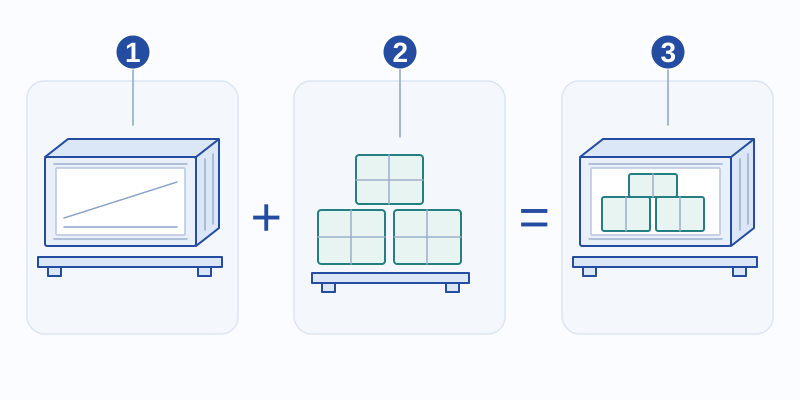
Visual reference
- Empty container
- Contents mass
- Total gross mass
Illustrative diagram, not to scale.
For the standard 40-foot documented fleet example, the values are a tare weight of 3 750 kg, a maximum gross mass of 32 500 kg and a maximum payload of 28 750 kg. They must be read together. Other specifications may describe a different construction and different limits: a difference in figures does not allow you to choose the most favourable value for the unit you are buying.
Why a 40-foot container does not carry twice the mass of a 20-foot container
In the two standard documented fleet examples, volume increases from 33.2 m³ for the 20-foot to 67.7 m³ for the 40-foot. Maximum payload, however, increases from 28 130 kg to 28 750 kg. These examples illustrate the difference between gaining space and gaining mass capacity; they do not define every container in these sizes.
For low-density stock, the extra length can be useful before mass becomes the primary criterion. For very heavy items, the remaining space does not mean that additional load is permitted. The choice must take into account the usable dimensions, total mass, local stresses, and the confirmed logistics scenario for your project.
| Your stock | Priority question | Additional verification |
|---|---|---|
| Furniture or bulky items | Does everything fit with packaging? | Door clearance and access to items at the back |
| Heavy distributed loads | What total mass remains in the container? | Distribution, floor, and movement limits |
| Machine on a few supports | What forces are transmitted to the floor? | Supports, entry method, and appropriate study |
| Evolving stock | What will be the most heavily loaded situation? | Organization, inventory, and updating of masses |
Calculating what will actually be moved
Start with an inventory: goods, packaging, pallets, shelving, equipment, and accessories that will remain in the container. For a fitted unit, add what is not already included in its confirmed tare weight. Check this point with the supplier to avoid forgetting equipment or counting the same element twice.
Indicate at which stage the calculation applies: empty delivery, movement with installed equipment, or collection after filling. An operation initially planned empty changes nature if products or equipment are added before the intervention. Update the information and obtain confirmation of the scenario rather than keeping the first quote as if it covered every situation.
Organizing masses along the entire usable length
The great length sometimes invites placing heavy loads near the door for easy access. This organization must be examined: the total mass does not inform about its concentration in one area, nor about the center of gravity of the whole. Draw the loads and indicate their mass, position, and points of contact with the floor.
The technical guidance for the example distinguishes mass limits from load distribution. For your unit, have the floor, supports, and securing checked by competent parties. Do not deduce an allowable local load by simply dividing a gross mass by the surface area of the 40-foot container. An empty volume at the other end does not cancel a concentration of forces.
- Draw the position of loads, not just their order of arrival.
- Identify machines, narrow supports, and concentrated loads.
- Specify the entry method and the equipment considered.
- Have the distribution elements suitable for the unit and use verified.
Distinguishing standard, High Cube, and equipped configurations
A High Cube offers a different height, but this designation does not define a tare weight or payload identical to those of a standard. A refrigerated container has a body and a unit specific to its configuration. A container with side opening or double doors also has its own particular construction. Therefore, take the data of the proposed model, without carrying over the line from another table.
For an office or converted container, request the mass in its actually delivered state and the relevant documentation after fitting. Specify what you will add afterwards. The masses shown on an original data sheet cannot be used without examination when the project includes equipment or modifications not described in that sheet.
Preparing transport, access, and placement of the 40-foot container
The length of the 40-foot container requires describing the approach and final position in addition to the mass. Send a plan with site entrances, turns, obstacles, and the unloading area. Specify the orientation of the doors and the side that must remain accessible. The carrier must be able to study the vehicle and the route corresponding to the planned operation.
The handling provider examines its equipment, configuration, and intervention conditions for the actual mass. The preparation of supports and ground must also be defined with the relevant professionals. The container's limits do not replace the vehicle or route limits, nor the study of lifting or placement. If a point of the site remains unknown, indicate it rather than presenting it as established.
Comparing a 40-foot container with other stock organizations
A long space can simplify the storage of long items or the centralization of equipment. Two shorter units can meet a separation of uses or locations, but involve different deliveries and organization. Compare proposals with the same stock and site information; no automatic equivalence of budget or handling follows from the number of containers.
Consult the 40-foot references and the dimensions guide to verify space and passages. To compare masses with another format, use the 20-foot weight guide while keeping the technical examples distinct. In your request, describe the contents, destination, and planned movement: the offer must confirm the unit and distinguish container, taxes, transport, and unloading.
Your file for a move or delivery
- Identifier, configuration, and documentation of the selected unit.
- Tare weight in the actual state, including fittings and equipment.
- Inventory of contents with complete masses and situation at the time of movement.
- Plan of loads along the length and characteristics of concentrated supports.
- Access, maneuvers, obstacles, door orientation, and final position.
- Coordinate transport, handling and ground preparation for the same delivery scenario.
Practical questions
Is the empty weight of every 40-foot container 3 750 kg?
No. That is the tare weight of the standard documented fleet example presented here. Manufacturers, versions, equipment, and conversions can change the mass. Request the data of the proposed unit.
Can a 40-foot container hold the contents of two 20-foot containers?
It depends on the dimensions, mass, and loading plan. In the cited examples, the volume is significantly larger, but the payload is not doubled. You must compare the actual stock to the limits of the selected unit.
Is the High Cube always capable of supporting heavier loads?
The extra height is not enough to answer. Check the tare weight, maximum gross mass, and payload of the relevant version, as well as the distribution and movement conditions.
Is a container under its maximum gross mass ready to be lifted?
No. The overall mass is only one piece of information in the file. The provider must examine the equipment, configuration, distribution, access, and operation conditions before confirming the method.