Choose a refrigerated container around the goods, temperature and access routine. A 20-foot and a 40-foot container provide different capacities, but size does not establish the refrigeration unit’s temperature range. Start with a clear requirements list. Your project for Estonia: use this guide to prepare placement alongside the technical container choice. Include the building or site name when it helps identify the correct entrance. Specify the entrance the truck can actually use, especially if it differs from the main address. To start comparing a specific reference, see Container 20 ft Refrigerated · Used · last trip · Beige.
Specify a setpoint and tolerance
State the required temperature, for example +4 °C or −18 °C, and the permitted variation for your goods. These are enquiry examples, not guaranteed catalogue performance. Add volume, incoming product temperature, packaging, storage duration and daily door openings.
Compare the refrigeration unit, not just volume
Request make, model, operating range and capacity at your site’s ambient temperatures. Distinguish holding already cold goods from rapid cooling, which needs separate validation. Specify ventilation, humidity and recording according to the contents.
Plan power and air circulation
Obtain voltage, phases, frequency, power requirements and connector details from the unit plate and have an electrician check your installation. Draw pallet positions and access. Keep the floor airflow paths and marked load limit clear according to the unit’s loading plan.
Request a useful operating test
For a used reefer, ask for a pre-use unit inspection, maintenance history and operating record showing setpoint, ambient temperature and test duration. Examine seals, doors, insulation and alarms. Compare purchase, power installation, servicing and delivery on equal terms.
Which cooling requirement should you describe?
| Requirement | Information to provide | What the offer should confirm |
|---|---|---|
| Chilled storage | Product-specific setpoint, tolerance and access routine. | Suitable operating range, ventilation and monitoring. |
| Frozen goods | Incoming temperature, negative setpoint and volume. | Holding that setpoint in your ambient conditions. |
| Rapid cooling | Mass, starting temperature and required time. | Validated capacity and process; do not assume reefer suitability. |
| Frequent access | Number and length of openings, peak periods. | Recovery after openings and loading organisation. |
CONTAINER ORIGIN
Information to send to the supplier
- Goods, volume and packaging.
- Written setpoint and tolerance.
- Incoming product temperature.
- Door openings and site conditions.
- Checked power supply and connection.
- Test, monitoring, servicing and postal code.
Explore suitable models
Compare catalogue references
Container prices exclude tax. Delivery and unloading are quoted using your postal code. Specify equipment and the actual offered unit’s performance in the supplier offer.
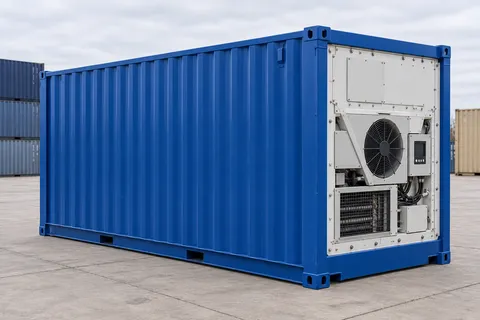
CA-20-REEFER-NEW-BLUE
Container 20 ft Refrigerated · New · one trip · Blue
New · one trip / Blue
€22,017Excluding tax
Request an offer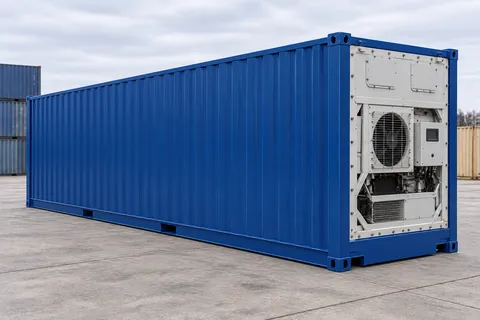
CA-40-REEFER-NEW-BLUE
Container 40 ft Refrigerated · New · one trip · Blue
New · one trip / Blue
€26,752.5Excluding tax
Request an offer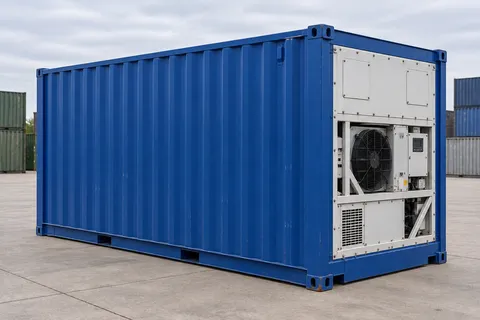
CA-20-REEFER-A-BLUE
Container 20 ft Refrigerated · Used · excellent condition · Blue
Used · excellent condition / Blue
€7,749Excluding tax
Request an offerPractical questions
Can every refrigerated container reach −18 °C?
The refrigerated label does not guarantee a universal operating range. Confirm the setpoint against the unit model, condition, ambient temperature and load, and request a documented operating test.
Does a 40-foot container cool more strongly than a 20-foot one?
It offers more space. Performance also depends on the unit, insulation, loading and operating conditions. Compare specifications and test records rather than inferring cooling capacity from length.
Can I load warm goods?
Do not plan a temperature pull-down without validation. Specify mass, incoming temperature and required time. For routine refrigerated holding, goods should arrive at their required storage temperature.
Is an ordinary power socket sufficient?
Do not assume it. Refrigeration unit supplies vary; request plate and connector details. Price connections and protective equipment before delivery, including a power-outage plan if your contents require one.
What should I prepare to request a project quote for Estonia?
Provide the town, street and placement-site number, or a precise landmark if the land has no number. Postal code: 5 digits, retaining any leading zero. Format example: 10111. Use your site’s code, not this example. Include the building or site name when it helps identify the correct entrance. Specify the entrance the truck can actually use, especially if it differs from the main address. The proposal should confirm transport, unloading, availability and timing for this site.