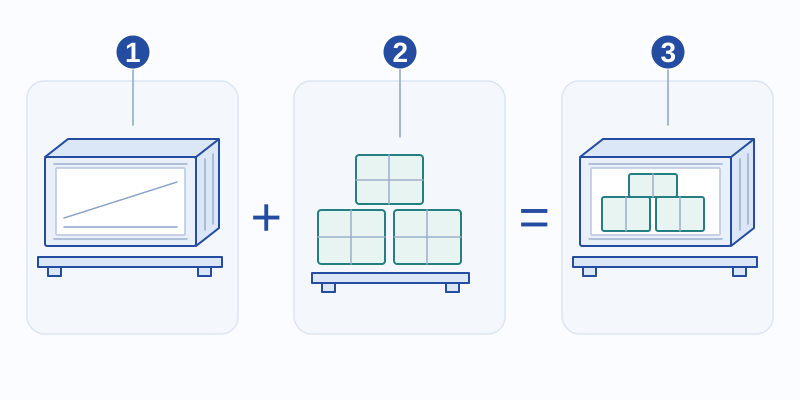
To find out how much a 40-foot container weighs when you need to move it, look at what's inside and what equipment it has, not just its length. It gives you more space, but it can't necessarily carry the contents of two 20-foot containers. Available space and allowed weight are two different limits.
The example model on this page is a standard 40-foot container weighing 3,750 kg empty. It does not describe the container you are buying. Ask for the tare weight and limits of your container, then pass this information on to transport and handling professionals.
Documented example · 40-foot standard
| Tare · empty weight | 3,750 kg |
|---|---|
| Maximum payload | 28,750 kg |
| Maximum gross mass | 32,500 kg |
Example from a documented fleet, checked on 16 October 2026. Values vary by manufacturer and do not describe Container Origin stock. Check the selected unit’s markings and documentation.
Calculate the mass to move
Calculation example: 3,750 kg tare + 10,000 kg contents = 13,750 kg to move. This example does not authorise loading or lifting your unit.
Distinguishing empty weight, contents, and total limit
Tare is the weight of the container without its load. Maximum payload is the limit for the contents. Maximum gross mass is the limit for the container and its contents together. To calculate the payload, subtract the tare from the maximum gross mass. You still need to check how the load will be distributed and moved.
Visual reference
- Empty container
- Contents mass
- Total gross mass
Illustrative diagram, not to scale.
For the standard 40-foot example model, the tare is 3,750 kg, the maximum gross mass is 32,500 kg, and the maximum payload is 28,750 kg. These values go together. Other models have different construction and limits. You cannot pick the most favorable figures from several spec sheets and apply them to the container you are buying.
Why a 40-foot container doesn't carry twice the weight of a 20-foot container
In the two standard example models, volume goes from 33.2 m³ for the 20-foot to 67.7 m³ for the 40-foot. Yet the maximum payload only goes from 28,130 kg to 28,750 kg. So gaining space does not let you double the loaded weight. These figures apply to the models mentioned, not to all containers of those sizes.
Light but bulky items can fill the container before you reach its weight limit. For heavy pieces, the remaining space doesn't mean you can add more load. Check the interior measurements, total weight, forces under the supports, and the planned transport conditions.
| Your stock | Priority question | Additional check |
|---|---|---|
| Furniture or bulky items | Does everything fit with packaging? | Door clearance and access to items at the back |
| Heavy distributed loads | What will be the total weight of the stored items? | Distribution, floor, and movement limits |
| Machine on a few supports | What weight does each area of the floor carry? | Support points, loading method, and an assessment of the loads on the floor |
| Evolving stock | What will be the most heavily loaded situation? | Organization, inventory, and updating of masses |
Calculate what will actually be moved
List the goods, packaging, pallets, shelving, equipment, and accessories that will stay in the container. If it's fitted out, add only what isn't already included in its confirmed tare weight. Check this with the supplier so you don't forget anything or count equipment twice.
Specify when the weight is calculated: empty delivery, moving with installed equipment, or pickup after filling. Adding products or equipment changes a job planned to move an empty container. Update the information and get the new method confirmed. The first quote doesn't automatically cover every situation.
Spread the weight along the length of the container
It can be tempting to put heavy loads near the door so they're easy to reach. Have this layout checked: the total weight doesn't tell you if it's concentrated in one spot or where the center of gravity is. Draw each load with its weight, position, and the points where it touches the floor.
The technical documents for the example distinguish between total weight and load distribution. For your container, have the floor, supports, and securing checked by professionals. Dividing the gross mass by the floor area of the 40-foot container doesn't give the allowed weight under each support. Empty space at the other end doesn't reduce concentrated forces in one spot.
- Draw the position of loads, not just their order of arrival.
- Identify machines, narrow supports, and concentrated loads.
- Specify how the goods will be loaded and which equipment you plan to use.
- Have the supports that will distribute the load checked for this container and this use.
Use the data for the standard, High Cube, or equipped model you've chosen
A High Cube is taller, but it doesn't necessarily have the same tare weight or payload as a standard. A refrigerated container has its own body and refrigeration unit. Models with side opening or double doors also have a particular construction. Use the data for the model being offered, without copying it from another table.
For an office or converted container, ask for the weight and documents after the work is done, in the condition it's delivered. Also say what you'll add. An old data sheet isn't enough if it doesn't describe the equipment or modifications that are present.
Preparing transport, access, and placement of the 40-foot container
To deliver a 40-foot container, the carrier needs the approach route and the final position, in addition to the weight. Send a plan with the entrances, turns, obstacles, and unloading area. Indicate which way the doors face and which side must stay accessible. That way they can check the vehicle and the route for the planned operation.
The handling provider checks their equipment and working conditions based on the actual weight. Also have suitable ground preparation and supports planned for the job. The container's weight limit doesn't replace the vehicle and route limits, or the assessment of the lifting and positioning method. Point out any information about the site that's still unknown.
Comparing a 40-foot container with several shorter containers
A long space can make it easier to store long items or keep equipment together. Two shorter containers can separate uses or locations, but they require different organization and deliveries. Compare offers with the same stock and the same site information. The number of containers alone doesn't tell you the budget or handling method.
Check the 40-foot models and the dimensions guide to verify space and passages. To compare with another size, read the 20-foot weight guide while keeping the data for each example separate. Describe the contents, address, and planned move in your request. The offer must confirm the container being proposed and separate the container, taxes, transport, and unloading.
Information for preparing transport or delivery
- Number, model, and documents of the chosen container.
- Tare weight in its actual condition, including fittings and equipment.
- List of all contents and their full weights at the time of the move.
- Plan showing the loads along the container and the size and position of their support points.
- Access, maneuvers, obstacles, door orientation, and final position.
- Transport, handling and ground preparation planned for the same operation.
Practical questions
Is the empty weight of every 40-foot container 3,750 kg?
No. That is the tare weight of the standard model shown as an example. The manufacturer, version, equipment, and modifications can change it. Ask for the data of the container you are offered.
Can a 40-foot container hold the contents of two 20-foot containers?
It depends on the dimensions, weight, and loading arrangement. In the examples, the volume increases significantly, but the payload does not double. Compare your stock to the limits of the container you choose.
Is the High Cube always capable of supporting heavier loads?
Being taller is not enough. Check the tare weight, maximum gross mass, and payload of the model, as well as the load distribution and movement conditions.
Is a container under its maximum gross mass ready to be lifted?
No. The total weight is only one piece of information. The service provider must also check the equipment, load distribution, access, and working conditions before confirming the lift.