To choose a container, start by listing what you want to put in it and how you'll use it. Then you can choose the size, doors, height, and condition. Also check the site and the total delivered price. A cheap container won't be a good deal if your equipment doesn't fit through the door or if the truck can't drop it off at your place.
The catalog lets you compare models and their equipment. Before buying, ask for details about the actual container the seller is offering you. If you're unsure about the model, describe your project in the quote form. A list of your items, their measurements, and a few photos will help the seller advise you. A model to compare: Container 20 ft Standard · Used · last trip · Beige.
Start with what you want to store
Do you want to store tools, keep parts you take out every day, protect equipment during work, or set up an office? Specify for how long and who will use the container. Products sensitive to moisture or temperature require different checks than a stock of materials.
Note the dimensions, weight, and quantity of the objects. Point out those that must stay upright or on the floor, and those you can stack. Also think about entries and exits: will you need to reach an object every day or leave the stock in place for several months? This will help you plan the aisles, doors, and height you need.
Draw the layout to choose the size
The 10, 20, and 40 foot containers are about three, six, and twelve meters long on the outside. Check the spec sheets for exact measurements. Exterior dimensions are for preparing the space on your site. To know what will fit, check the interior measurements and the door opening. The footprint on the ground isn't all available for storage.
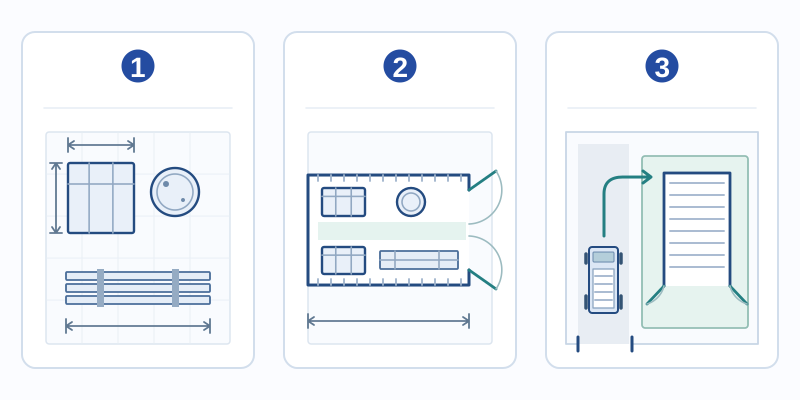
Visual reference
- Inventory
- Size and configuration
- Site and placement
Illustrative diagram, not to scale.
On a scale drawing, place the objects, shelves, and walkways. A small container may be enough for limited storage. A 40-foot gives you more length without a partition. Two containers can be more practical if several teams or several locations need them. The 20 or 40 foot guide helps you choose with a real storage plan, not just a number of cubic meters.
Check the doors and height
If the doors are at the end of the container, measure the clearance needed for your largest object and the space in front of the doors. An object may fit inside but not pass through the door, which is sometimes lower. A double door model gives access from both ends. A side opening can make loading easier for objects spread along the whole length.
Look at High Cube models if you're short on height. For loading from above, an Open Top can be a solution, with suitable lifting equipment. In both cases, ask for the exact measurements, the space needed for loading, and the list of included equipment. The model name alone isn't enough to confirm that your equipment will fit.
| Your need | Model to look at | What to check |
|---|---|---|
| Storage accessible from the end | Standard | Door and storage plan |
| Tall objects | High Cube | Interior height and door height |
| Access from both ends | Double door | Location and clearance of both accesses |
| Load objects from the side | Side opening | Clear opening and loading method |
| Loading from the top | Open Top | Lifting equipment and usable opening |
| Controlled temperature or workspace | Refrigerated or office | Equipment, power supply, and detailed services |
Choosing between new and used
A label like "good condition" or "very good condition" gives you a first idea. Still ask for recent photos of the floor, roof, sides, doors, and seals. Ask about any defects, repairs, odors, and marks you see. Catalog images show a model, not necessarily the container you'll be sold.
A used container can be enough if its condition suits what you want to store. A new container might interest you for its appearance or for a particular project. Ask the seller what they mean by "new," "first trip," or "last trip." These labels alone don't prove the container is authorized for your transport or equipped for the planned activity.
For an office or refrigerated container, ask for the equipment list
For an office, specify the number of people, the layout you want, and the equipment you need: windows, ventilation, insulation, electricity, or connections. Ask for a plan with measurements and a list of what's included. Also check the rules that apply to your activity and installation site. The label "office" alone does not confirm that the container meets those rules.
For a refrigerated container, state the products to store, the desired temperature, how often the doors will be opened, and the operating conditions. Have the refrigeration unit, power supply, tests performed, and equipment condition specified. An insulated box doesn't replace a working refrigeration unit. Choosing between 20 and 40 feet alone doesn't tell you if the cooling will be sufficient.
Check the site and the total delivered price
Look at both the spot where you'll place the container and the truck's route. Measure the entrance, turns, and slope. Also note branches, cables, and other overhead obstacles. On your plan, leave room in front of the doors and for moving around. Send photos of the route and the location. Have the supports and unloading method confirmed as suitable.
Compare quotes with the same services: container purchase, transport, unloading, options, works, and taxes. Catalog prices are indicative and don't include delivery to just any address. Ask what still needs to be priced and what you'll have to arrange yourself. Also check local rules for installing and using the container: they can vary from one country or place to another.
Review the quote and check the delivery
In your request, state what's essential and what's a preference. An object that must stay upright, a door width, or a quantity to store are specific needs. Color may be less important to you. If you're unsure, ask the seller to compare possible models and their prices. Sending a quote request doesn't count as an order.
Before confirming the purchase, review the model, promised features, expected date, and full price. At delivery, check that the container and services match what was agreed, according to the seller's conditions. Keep photos and documents. The clearer your needs are in the quote, the easier it will be to verify that the delivery meets them.
Information to prepare before requesting a quote
- What you want to store, who will use the container, and for how long.
- The dimensions, weight, and quantity of the items, along with stacking options.
- The sizes and models you're considering, as well as any uncertainties you have.
- The condition you want, recent photos, and checks to request.
- For an office or refrigerated unit: the equipment, connections, and tests needed.
- The number of containers, the address, photos of the access, and the installation plan.
- The desired date, unloading, and services to include.
- The detailed total price and conditions to check before buying.
Find the right type of container
Practical questions
Can you choose a container just by its volume?
No. Measure your items, check the doors, and plan how to load and arrange them. If you take equipment out every day, you'll also need to keep aisles clear to reach it.
How do you choose between a new and a used container?
First, check whether the container will protect what you want to store. Compare its actual condition, defects, repairs, and the total delivered price. The label 'good condition' doesn't replace photos and inspections.
How do you ask for advice without knowing the right model?
Explain what you want to store, the measurements you have, and the delivery address. Add photos. The seller can help you choose; mention what you don't know yet rather than picking a model at random.